Papers chart mind of early mapmaker
Long-lost 16th century manuscripts written by the cartographer Gerardus Mercator have been rediscovered.
Koenraad Van Cleempoel was sifting through leather-bound folders at the El Escorial monastery near Madrid when he saw “elegant cursive handwriting” that he recognised. The professor, from Hasselt University, Belgium, said: “One of the librarian monks ... gave me a folder containing some mathematical manuscripts. I thought, ‘This could really be something.’ ”
Mercator, who was born in 1512 and died in 1594, was one of the most important figures of the Renaissance.
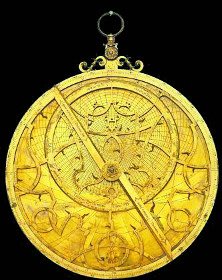
His terrestrial globe in 1541 was followed by his celestial globe in 1551 and a planispheric astrolabe, right, an astronomical instrument. His work coincided with exploration that increased demand for maps as tools of navigation. He is best known for the Mercator “projection” of the world as a flat map in 1569, still the conventional “projection” of the earth’s shape on a flat surface.
Van Cleempoel said: “The manuscript lets us follow Mercator as he thinks, calculates and designs. That makes this manuscript priceless.”
The manuscript is now the subject of a PhD research project by Yves Verspreet, a long-time river captain and pilot, who has expertise in 16th-century globe-making and navigation.


