Friday, November 28, 2025

DG25001 Gerardus Mercator - Map Maker V01 291125

 Papers chart mind of early mapmaker

Long-lost 16th century manuscripts written by the cartographer Gerardus Mercator have been rediscovered.

Koenraad Van Cleempoel was sifting through leather-bound folders at the El Escorial monastery near Madrid when he saw “elegant cursive handwriting” that he recognised. The professor, from Hasselt University, Belgium, said: “One of the librarian monks ... gave me a folder containing some mathematical manuscripts. I thought, ‘This could really be something.’ ”

Mercator, who was born in 1512 and died in 1594, was one of the most important figures of the Renaissance.

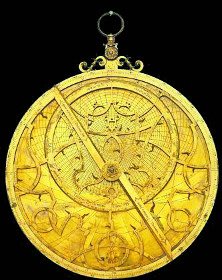
His terrestrial globe in 1541 was followed by his celestial globe in 1551 and a planispheric astrolabe, right, an astronomical instrument. His work coincided with exploration that increased demand for maps as tools of navigation. He is best known for the Mercator “projection” of the world as a flat map in 1569, still the conventional “projection” of the earth’s shape on a flat surface.

Van Cleempoel said: “The manuscript lets us follow Mercator as he thinks, calculates and designs. That makes this manuscript priceless.”

The manuscript is now the subject of a PhD research project by Yves Verspreet, a long-time river captain and pilot, who has expertise in 16th-century globe-making and navigation.

Wednesday, August 7, 2024

DG24015 Walks in Shakespeare Country 1989 V01 070824

Link below to a PDF copy of  the "Walks in Shakespeare Country Book"below 


https://drive.google.com/file/d/1VvTfiC2qiAf1XY555xANij4uEx9e4Bp6/view?usp=sharing


As a Writer and Publisher, I remain truly amazed at the speed in which a popular genre in the books industry can suddenly appear and then just as suddenly disappear due to changes in Information Technology. The concern is without the digital capture and sharing of a book like this one the fact they ever existed will never be recorded and archived. Their very existence will not be known about by future generations.

So what do we mean by genre. A genre is a category or classification used by a group of works based upon shared characteristics, themes or styles. The particular book genre here is independently published walking guidebooks covering the period 1985 to 2005. The trigger point to the development of this genre in 1985 was the arrival of cost effective and capable personal computers for home use with effective word processing applications. Without the existence of digital cameras and digital maps (late 1990’s) along with the nonexistence of effective digital image processing software the maps, diagrams and pictures in these books were hand drawn in pen and ink. They were then just literally cut and pasted (real scissors and real glue) into the word processors printed on paper text book master. Although some like me had started to use the Ventura Publishing, Desktop Publishing Package (DTP) released running on a GEM frontend and DOS operating system only later moving to Windows. I was lucky owning a very early Tandon PC running GEM which I had purchased from my very enterprising Chinese friend, Boon Leng, importing and selling them from his garage in Redditch.  Authors of these walking guides often located a gifted artist in the pen and ink medium to create the imagery they included in their books having written the text. In my case it is often this artistry within these books that appeals to me rather than the walks themselves. Pencil and pen and ink drawings have always held my fascination for artwork.


Then having established the genre of walking guide books they just as suddenly disappeared and stopped being published. Larger publishing businesses, but not the very large, had taken on board some of the authors of these guides and looked to establish a national brands for them. So “Family Walks” (circa 1992) by Scartin Books, Cromford, Derbyshire built up over 30 books in a standard style using photographs in the books. Now a secondhand bookshop in Matlock, Peak District, its to my knowledge no longer a book publisher.  Similarly Countryside Books , Newbury, Berkshire founded in 1976 with their Waterside Walks Series adopted a similar style and approach. Both still retained hand drawn maps and a few pen and ink sketches to uphold the genre. In fact Countryside books is still (2024) active in selling Walking Guide books.

So why did they then suddenly disappear.

Well from say 2005 the internet became more widely accessible and websites started offering digital maps and trail information that could be kept more “ real time” than was possible with the timescales required by the book printing and publishing processes. A change to a walk could be instantly communicated. Then from 2007 with the release of the Apple Smartphone offering portable digital maps and navigation apps destroyed the demand for walking guide books apart from the die hard book enthusiasts. From 2010 onwards there was a proliferation of dedicated apps for hiking, walking and outdoor activities and the fact these could now be carried in your pocket accelerated the decline of physical guide books. The fact that physical printed guide books could become quickly out of date with their content really determined their fast demise. The linking of these new Smartphone apps into the Social Media world at the same time as smartphone photography becoming so effective really defined the end for these printed walking guide books. In fact the new generation of walkers had often never seen these old walking guide books with them quickly becoming viewed as a product of antiquity occasionally found in Charity Book Shops for a few pounds.      


So back to this 20 year period between 1985 to 2005 in which the printed book walking guide was to develop and flourish.  This book walking guide genre developed its own unique style and typical content listed below. Early ones were truly independently produced by a walking enthusiast come author but over time larger publishing businesses, although never the very large ones, looked to build up lists of books traded under specific branding.

      Content

1.    A high level map showing all the walks in the area normally indexed

2.    Individual walks having a geographical map showing the location and route

3.    A description of the undertaking the walk itself

4.    Relevant local history covering people and places

5.    Pen and ink sketches of sights seen on the walk, often buildings

6.    Diagrams in support of knowledge transfer about things on the walk

7.    Normally just black and white printing no colour apart from the cover

8.    No photographs but sketches instead by a local artist

9.    Details of local businesses, public houses, hotels and B&B’s etc

10. Car parking locations 


Each walking guidebook had its strengths and weaknesses based upon the author’s abilities and knowledge plus that of the local artist. This particular guide, Walks in Shakespeare Country by Joe Taylor and Chas Cook with artist Jenny Taylor, scores very highly in the historical text content. It reads like an excellent history book relevant to the walk. Like my view of all the written descriptions of the walks this suffers from getting you quite confused. Describing a walk is a particularly difficult thing to do with my preference for just  outlining what can be viewed  at the marked waypoints on the map of the walk.

A PDF copy of the original book is linked to above from this blog but by you using it you are subject to my normal Copyright statement below.

Publisher Copyright of  “Walks in Shakespeare Country” is acknowledged as the Thornhill Press whilst author copyright belongs to Joe Taylor and Chas Cook.

DMB Publishing the Digital Publisher of this digitised copy operates on a strictly non for profit base, whilst it is shared here strictly under a Creative Commons 4.0 Licence defined by CC BY-NC-SA 4.0 Deed. The copyright owners are acknowledged and if there is any objection to this digitised copy being shared the content will be immediately removed from the internet. The sole objective of its publication on the internet is to raise public awareness of this publication whilst ensuring its retention for posterity so future generations can have access to its content.

This is not a currently published book offered for sale with this ceasing from a publishers perspective over 25 years ago.


It should be noted second hand copies are readily on sale on internet second hand book web sites starting from £4 (Date : 070824) and you are encouraged to buy a copy to avoid their destruction or going to landfill. We need to retain books as important historic artefacts to be retained for use by future generations.       


Monday, April 8, 2024

DG24014 The Geopark Way 2008 V01 080424

It is difficult to imagine how anyone would discover this 109 mile walk from Bridgenorth to Gloucester focussed upon the geological aspects without being interested in geology. To be honest although it has been defined as a walk it lacks any real what I term landscape synergy except for those particularly interested in geology. Devised by the Herefordshire and Worcestershire Earth Heritage Trust linked to Worcester University. In my view it would benefit from re-branding as the Abberley, Malvern and May Hills Way reducing both its geological focus and its walking distance accordingly. Geologically it could then be focussed upon the Silurian Marine Rocks which have resulted in an intermittent mountain like landscape with a line running southward from Abberley through the Malverns and then to May Hill. From a walker’s perspective this would cover the ranges of hills that offer such  splendid mountain like views. Although for the non long distance walkers this also supports better those arriving by car looking to undertake shorter circular walks at specific locations.

So how did I discover this Geopark Way? In driving north west along the A448 from Redditch to Bromsgrove I always mistook a set of hills I could see on my left side as being the Malvern Hills since they had a similar profile but I was aware they were too far north. Upon investigating I realised they were the Abberley Hills. Then similarly driving down south on the M5 I could see a set of hills beyond where the Malverns ended. This was May Hill leading into the Forest of Dean. The epiphany moment was realising that geologically their peaks were made of the same rock type resulting in them resisting erosion and forming what I term a “mountain like landscape” in a normally “rolling hills” type landscape. Having visited all three locations, Abberley Hills, Malvern Hills and May Hill, they all offer an outstanding experience although the Malvern Hills offers the most exceptional visual views experience.

I have included a free link to The Geopark Way Guide to really advertise this walk. It is a First Edition dated 2008 and I would encourage you to go to the Shop on their website below to buy an up to date Second Edition copy for £15. They also sell other useful local printed resources. You do get the impression that the activity level on publicising this particular Geopark Way walk is low (2024) with efforts going into other geological projects like Birmingham Erratic Boulders project. Although this is symptomatic of the whole geographical, historical and geological activities in the United Kingdom as funding becomes more difficult and the dependence on volunteers increases. With both Central Government, Local Council and University funding all being cut back all I can say is thanks to Lottery Funding some movement is still being financed. These initiatives are becoming more dependant on charitable donations and volunteers doing the work. In my small way this is about me encouraging you the reader into locating an interest you would like to support.

Link to a free copy of The Geopark Way Guide subject to defined Copyright Rules below.

https://drive.google.com/file/d/1IKRA-Objh1sAizs0oFoQTN7JPYI0UdZ_/view?usp=sharing


If you have little time to spend exploring the Geopark Way I recommend three must visit locations below.

Section 7     Abberley to Martley              Page 60           Viewpoint 26

Section 10   North Malvern to Colwall      Page 82           Viewpoint 51

Section 15   Newent to Huntley                Page 114         Viewpoint 69


Link to the Earth Heritage Trust

 www.earthheritagetrust.org


Publisher Copyright of "The Geopark Way" is acknowledged as the Herefordshire & Worcestershire Earth Heritage Trust.  DMB Publishing the Digital Publisher of this digitised copy operates on a strictly non for profit basis, whilst it is shared here strictly under a Creative Commons 4.0 Licence defined by a CC BY-NC-SA 4.0 Deed. The Copyright owner is acknowledged and if there is any objection to this digitised copy the content will be immediately removed  from the internet. The sole objective of its publication on the internet is to raise public awareness of the existence of The Geopark Way and to encourage readers to purchase the latest The Geopark Way Edition 2 from the Herefordshire & Worcestershire Earth Heritage Trust website listed above.    .  


Friday, March 29, 2024

DG24013 Charm of the Cotswolds Book 1999 V01 290324

The Cotswolds was named an Area of Outstanding Natural Beauty (AONB) but it was renamed by the Government as a National Landscape in November 2023 in a rebranding exercise. There are 46 National Landscape areas in England, Wales and Northern Ireland. The Cotswolds is the nearest National Landscape to my home in Redditch, Worcestershire so it has become a regular go to location to experience a change in landscape, culture and charm. The word “charm” well describes why the Cotswolds is such an attractive destination. In my case it always provided such a different upland setting in contrast to the lowlands of Worcestershire and Warwickshire. With it only one hour away you could instantly transform yourself into a different world. As a family we always look to make such a visit every Spring just as the daffodils are blooming. For special family celebrations we always looked to head to the Cotswolds. Oddly enough our destination is normally Broadway which is not  located on the Cotswold escarpment but at the foot of Broadway Hill (sometimes called Fish Hill) just beneath the escarpment edge. Although Broadway, in fact in  the Vale of Evesham,  is entirely Cotswold in character with its many honey coloured stone buildings. The village has Tudor, Stuart and Georgian houses, farm labourer’s cottages, hotels. inns, and shops. Just a visit to Broadway can give you a spiritual uplift with it being so different.

Now to the book “Charm of the Cotswolds” which was published by Readers Digest Association in 1999. The Readers Digest Association invested enormous effort into publishing these amazing books. It is difficult to appreciate that this book creation activity, upon which the publishing industry was based, has now passed with the arrival of the internet. Factual books have overnight lost their commercial value with the justification for investing in their publication now in most cases gone. Consumers now want their information screen based not paper based. This book was £1.50 in a Charity Shop with it likely if not purchased to end up in landfill. Somehow the digital substitutes for books like this will never offer the same depth of experience you get reading it in a book format. Screen based information these days is so fragmented and the effort to produce such book masterpieces is no longer justified since no return can be made on the investment. Factual books are disappearing from our society in a mass exodus and in 10 years’ time they will be considered a rarity with those that do get published very expensive to purchase. You can already witness the rarer ones in perfect condition selling for hundreds if not thousands of pounds. So let us enjoy them whilst we can still read them all be it in a PDF format here.

So what appealed to me about this book was it had within it essentially another book which Readers Digest had syndicated which was originally published as “A Year in the Cotswolds” by John Hudson. John lives in the Cotswolds and based the book on looking at Cotswold life through the seasons. He manages to convey in a unique style what living life in the Cotswolds feels like in fact embedding emotions into his writings in a subtle way. Upon reading his words you are going to fall in love with life in the Cotswolds. To write like this on a factual subject requires the author to have a particular gift as well experiencing Cotswold life on a day to day basis.


The Original John Hudson Book called "A Year in the Cotswolds" 

included in the "Charm of the Cotswolds Book".


The Charm of the Cotswolds is linked to below for you to read. It is likely that LinkedIn will block it because of its size so to read it you will need to go directly to my adigitalgeography.blogspot.com site and launch this post DG24013 dated 290324. So by removing LinkedIn from the software stack it should allow you to download it successfully. Read and enjoy it.


https://drive.google.com/file/d/1DzBkD3Y3X8dN2rfSfn9yQGeZ7UlPPvy7/view?usp=sharing


The one venue in Broadway we always enjoy for a meal or for an overnight stay is the Broadway Hotel.


 Broadway Hotel. Sit by the log fire on a dark Winter's Night. 

You will usually end up talking to some American Guests.  

Another popular Cotswold village we visit is Chipping Campden which although a lot less commercial than Broadway is sited on the top of the escarpment with the open sided Market Hall the starting point for the 102 mile Cotswold Way. 


 Chipping Camden High Street


For my 50th Wedding Anniversary we splashed out hiring a £1m property in Chipping Campden high street called Singer House for a Friday and Saturday night in 2019. This property looks so insignificant from the high street but in fact it was fabulous inside with our main bedroom used as a ballroom when it had access to much larger property sited to its left called Bedfont House.

The Google Street View Geotag for Singer House is included below this Street View photograph for you to use.


Google Street View of Singer House entrance grey door on the right.


Also subject to you having a TikToc Account take a look inside Singer House using the link below.


https://www.tiktok.com/@hannahfelicity2/video/7342566165715242272?is_from_webapp=1&sender_device=pc


Some more history on Bedfont House and Singer House

https://www.chippingcampdenhistory.org.uk/content/activities/projects/bedfont-house-and-the-griffiths-family/why-bedfont-house

Publisher Copyright of "The Charm of the Cotswolds" is acknowledged as the Readers Digest Association.  DMB Publishing the Digital Publisher of this digitised copy operates on a strictly non for profit basis, whilst it is shared here strictly under a Creative Commons 4.0 Licence defined by a CC BY-NC-SA 4.0 Deed. The Copyright owner is acknowledged and if there is any objection to this digitised copy the content will be immediately removed from the internet. The sole objective of its publication on the internet is to raise public awareness of the loss of such valuable books and to extend their time being read. Similarly the Copyright of the author of "A Year in the Cotswolds"  John Hudson is acknowledged and the same criteria defined above applies to his Copyright ownership. 

Monday, March 25, 2024

DG24012 Churchdown Hill , Gloucestershire V01 240324

There is an old expression applicable to both storytelling and writing that if you want to make a subject popular you must make it local. We are all guilty of having, in particular, our main historical and geographical interests confined to areas near where we live. It is amazing that with Social Media this enthusiasm for local interests has generated so many popular Local Groups with dedicated Administrators and Followers all willing to contribute their photos and stories. So in my case living in Redditch, Worcestershire my focus is upon South Worcestershire and South Warwickshire. But I owned a flat in Gloucester Docks for 17 years (2006-2023) so my focus was changed to this area of Gloucestershire. Being honest both historically and geographically the area around Gloucester had far more to offer than the areas around my home in Redditch. One of the outstanding geographical features was the Cotswold Escarpment and its outliers of Bredon Hill, Churchdown Hill and Robin’s Wood Hill. I have made it to the top of all three being taken back by the views. 

This post is focussed upon Churchdown Hill sometimes to confuse matters it is called Chosen Hill. Being an aviation enthusiast spending long periods at the Gloucester and Cheltenham Airfield at Staverton, Gloucestershire it offered a clear view of Churchdown Hill and you could even see St Bartholomews Church on top of it. It has a distinctive conical shape and rises to 607 feet (185 metres). So my initial objective was to climb it to view the airfield from a different perspective. Fortunately no climbing was involved since there is a narrow tarmac road that takes you right to the top with parking spaces. Once there the views are truly fantastic with all photographs failing to convey how high up you feel as you overlook the countryside. Inevitably it has become my go to destination especially if you want a setting to do some thinking and reflection.

Now whilst appreciating that geology inclusive of all the rock names makes the subject less attractive to most of the public it does account for the existence of many of the most striking geographical features with geology books highlighting these features. For many years I have owned “Geology Explained in the Severn Vale and Cotswolds” (1973) by William Dreghorn (1908-2001).The outstanding feature of this book is the inclusion of many sketches by William Dreghorn where they illustrate the subject of geology in a unique way with many oblique sectioned drawings of rock formations.

William Dreghorn's Book


Some sketches by William Dreghorn below out of this book.


Over the years I have viewed many maps showing the Cotswold Escarpment that the Cotswold Way runs along as a 102 mile walk from Chipping Camden to Bath but this map by William Dreghorn (1908-2001) is my favourite because of its simplicity and it shows clearly the Bredon Hill, Churchdown Hill and Robin's Wood Hill Outliers. With the Malvern Hills to May Hill being the other significant hills on the West side of the River Severn leading into the mysterious Forest of Dean.  


A simple sketch showing the rock formation below St Bartholomews
 Church on the top of Churchdown Hill. 


Some photographs taken by St Batholomews Church, Churchdown Hill, Gloucestershire.


A Google Geotag to a Steet View of St. Batholomews Church, Churchdown Hill, Gloucestershire.

http://www.google.com/search?q=51.8693188,-2.1730058


The Wikipedia link is below

https://en.wikipedia.org/wiki/Chosen_Hill,_Gloucestershire


William Dreghorn (1908-2001) spent his later years living in Cyprus where he contributed enormously to his new “local” setting. It once again emphasises the point that what is local to you most interests you. Although if you as a writer or artist document things as you progress through your life you can always go back to review and reflect on them.

View his bio on the link below.

https://cyprusscene.com/2016/07/17/william-dreghorn-exhibition-artrooms-girne-until-9th-september/

 With the constant danger of web resources you link to just disappearing I have copied some of the contents of this link below.

By Heidi Trautmann……

William Dreghorn (1908-2001)

Many friends and contemporaries of William Dreghorn had come together on the opening evening at the ArtRooms in Girne, Turkish Cypriot friends as well as British friends. He died in 2001, that was when we started building the house, and he was one of ‘the important things’ one learnt about Cyprus. I have never met him but have later written about some activities around his work initiated by the Dept of Antiquity, i.e. Prof. Dr. Müge Şefketoglu who knew him from childhood years and followed him – literally – with sketchbook and pen, and it is also her to whom I directed my questions when I was approached by collectors – the one in South Africa, the other in Los Angeles on the basis of my articles on my website; thus we received information of sketches and paintings which were not in the Cyprus collection. Internet the great communicator.

Dr. Sibel Siber said at the opening ….it is to honour William Dreghorn who has done so much for this country; she also wrote the introduction in the English and Turkish catalogue of his work which is a common effort of governmental and private initiatives.

Many buildings, images of streets and archaeological details would no longer be available to us if it was not for William Dreghorn. Also Erbil Arkin of the Arkin Group shared some private memories with us. Among the distinguished guests was also his 


doctor who sat by his side at the very end; even then he was asking for paper and pen to draw some things from memory, he told me.

To see some of the articles I have written about the work of William Dreghorn please click on the links below:

Castle Sketch Book by William Dreghorn – click here

A painting of St Hilarion by William Dreghorn – click here

William Dreghorn in Bellapais – click here

The exhibition  itself was beautifully prepared by Oya Silbery, the director of the gallery; she had welcomed the guests on the lower terrace of ‘The House’.  It was one of those melting tropical nights under a Mediterranean sky when you don’t want to go home and as I was moving from one group to another I heard all the stories people brought up from times when places like Girne and Famagusta were deserted and a man sitting for hours and sketching and painting away – Bill Dreghorn loved the Old Harbour  in Girne – would catch everyone’s eye.


There is a permanent exhibition in the castle – and what would Bill Dreghorn say if he could see Girne today – he would turn in his grave.  Yes, things have changed, especially these last ten years. We have somehow lost the patience to observe the details, and this is a good occasion to call that into our minds, with the beautifully drawn pictures of so many parts of our island, an old alley in the Old City, a fountain, a door or the stone works on a building, they are drawn not only for the love of detail but with his heart; you immediately feel at home when looking at them closely and you want to go and find them in reality.

Wednesday, March 20, 2024

DG24011 Aerofilms Archived Aerial Photographs (1919-2006) V01 200324

If you are a history or geography enthusiast that posts on Social Media sites like the popular “Then and Now” here is your opportunity to use a free site to get your historical black and white aerial photographs. You can now use the Aerofilms photographic archive to locate your "Then" photographs which has now been taken over by Historic England. A link to their website is included below in this post.

Whilst I the have always been a mapping enthusiast the maps that have always most appealed to me either drawn or photographed are the oblique genre where you can visually see buildings and geographic features laid out on the map but in a three-dimensional format. The classic purely vertical maps either drawn or satellite generated although interesting do not carry the aesthetic appeal of oblique maps. It is about maps being considered by me as artwork rather than purely having a scientific cartographical purpose. See a good example of Vertical verse Oblique Photographic Views on Page 6 of the Aerofilms Library Index Book linked to below in this post. It’s the use of oblique views in older historical maps that are  appealing to me. Whilst thanks to them now being very saleable over the internet that this genre is starting to appeal to our young contemporary artists.

It was not so long ago that Black and White Aerial Photographs were considered the most technically advanced way of viewing geography and history from the above. Back in 1962 I sent off for the 7/6d Library of Aerial Photographs produced by Aerofilms and Aero Pictorial Limited and proceeded to purchase some of their interesting photographs.

Here is the Leaflet advertising the booklet from which I decided to order their booklet.

https://drive.google.com/file/d/1iSiZcmSeJ6JU5PXT9QI-Y0iH23SNKdXW/view?usp=sharing 

Here is the Library of Aerial Photographs Booklet (1962) itself. It is 62 years old and has been on my bookshelf all of those years. I still enjoy looking through the photographs and appreciating how many exist covering a huge variety of subjects. It is the way they have structured content in the booklet by adopting a classic attempt at Library Classification that appeals to my data centric mind along with this also applied to the Appendices. No Google search in those days. (1962).

https://drive.google.com/file/d/1vGgXXE8pnf58Ao5QhSYTtn36tRww_FiO/view?usp=sharing 


It has to be acknowledged that although Google Maps and Google Street View have using GPS (Global Positioning System) satellite capabilities brought mapping into the 21st Century they cannot achieve the splendid oblique views that can be obtained from an aircraft. Now the advent of drones  can exceed all these oblique capabilities and once they are organised both nationally and internationally we will have the perfect oblique visual resources. These capabilities will be inclusive of both still and moving photographs (video) eventually extending into full 3D and virtual reality functionality. I am personally looking forward to “flying” down a river from its source to the sea under and over all the bridges from a drone perspective.

Its important to acknowledge the part played by Aerofilms Limited in both originally creating this archive and now handing it over to Historic England. In 1995 The Times reported that Aerofilms had 1.2 million photographs between 1919 and 2006 spanning over 75 years.

Read the Wikipedia link below on Aerofilms history.

https://en.wikipedia.org/wiki/Aerofilms

To use the Aerofilms Archive use the Historic England link below

https://historicengland.org.uk/images-books/archive/collections/aerial-photos/


By a strange coincidence in a recent old map book I purchased it had stored inside it the cover part of a Hunting Group Review dated February 1981 (Original owners of Aerofilms) with a cutting of an article on the so called Rampton Map Tapestry inside of it.

Link to part of the Hunting Group Review (1981) found in an old map book with the article on the Rampton Map Tapestry.

https://drive.google.com/file/d/1Eap-kXzeuugIrLbwAJsWUNtRqXWu0IRQ/view?usp=sharing


Link to details about the Rampton Map Tapestry on a European History Site.

https://www.europeana.eu/en/item/2064107/Museu_ProvidedCHO_Nottingham_City_Museums_and_Galleries_BLDIDCT166793


Oblique View of the Tower of London (Aerofilms)

Sunday, March 17, 2024

DG24010 The Appearance of Bridges 1996 V01 170324

Everyday you are travelling over or under bridges with most people just taking their appearance for granted. Back in 1964 the Department of Transport started to look at improving the visual excellence of bridges whatever their method of structural construction. This Appearance of Bridges Book produced in 1996 includes both bridges in the United Kingdom as well as those abroad. Although I would have preferred it to be the bridges of the United Kingdom only. But it has to be acknowledged that some of the most advanced aesthetic designs are to be found internationally.

This 192 page book (186.2 MB) will take some time to download so be patient. Likely to be 60 to 80 seconds. Click the three consecutive  Download displayed options and wait.  Once loaded adjust your PDF zoom as required by pinching open your fingers over a page. 

  https://drive.google.com/file/d/1cZyVar6SDu4hMCz4iFZ1fblKsYelqTQx/view?usp=sharing

Although it originally cost £35 it was purchased for £3.56 to save it from landfill and to preserve it for use by yourself and future generations.

Publisher Copyright is acknowledged as the Government Stationery Office. DMB Publishing the Digital Publisher of this digitised copy operates on a strictly non for profit basis, whilst it is shared here strictly under a Creative Commons 4.0 Licence defined by a CC BY-NC-SA 4.0 Deed. The Copyright owner is acknowledged and if there is any objection to this digitised copy the content will be immediately removed from the internet. The sole objective of its publication on the internet is to raise public awareness of the importance of good bridge design and to highlight the excellent work undertaken by the Department of Transport.

If you take the time to look at this book even if you only look at the photographs you will never drive under or over a bridge again without observing its design. The United Kingdom modern classics for me remain the Clifton Suspension Bridge, Bristol (Page 9), the Avon Bridge M40 Warwick (Page 31) and the Bridgenorth Severn Bridge (Page 86).


Bristol Suspension Bridge

DG25001 Gerardus Mercator - Map Maker V01 291125

  Papers chart mind of early mapmaker Long-lost 16th century manuscripts written by the cartographer Gerardus Mercator have been rediscovere...